30% of your revenue happens while you sleep
Founders don’t buy software during business hours, they buy software when it’s most convenient for them. That often happens after hours at 9 pm, 12 am, or even
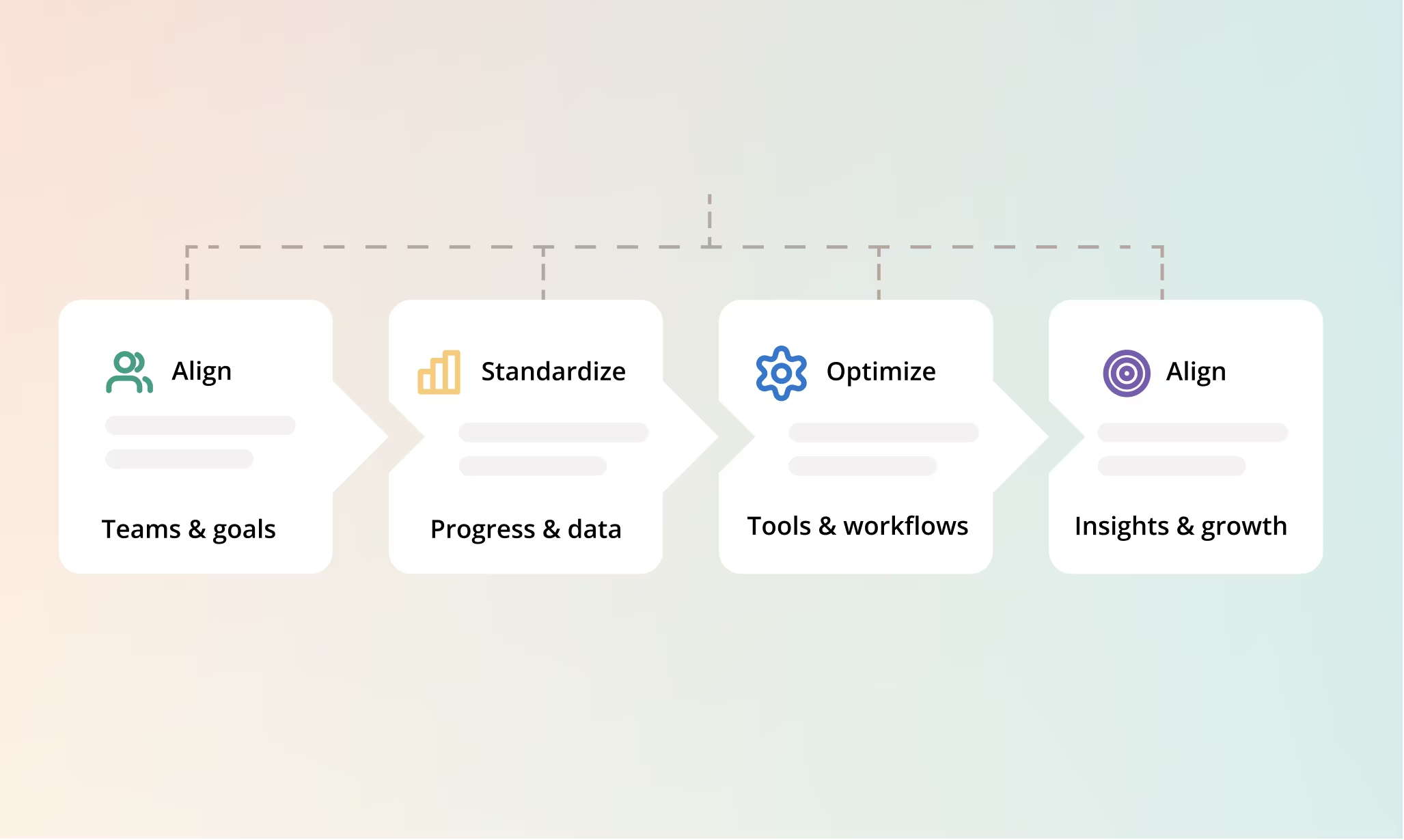
You’ve outgrown the patchwork of Stripe, a CRM, and manual Google Docs. As deals get more complicated and you scale the team, you’re likely seeing three different departments running three different sets of numbers with zero forecast confidence. When Finance, Sales, and CS can’t agree on the numbers, growth feels more like guessing.
We’re breaking down exactly how revenue operations solve this. You’ll learn how RevOps is different from traditional sales ops, the four essential pillars for growth, and which metrics actually matter at your stage. Most importantly, we’ll uncover where bad data quietly wrecks your forecasting so you can decide what to build first for your early-stage SaaS.
Revenue operations (RevOps) is the function that aligns marketing, sales, and customer success around shared goals, shared data, and shared processes across the full customer lifecycle, from first touch to renewal.
Each of those three words does real work:
In practice, RevOps is usually what happens when a company gets tired of the alternative.
Without RevOps, a deal might close on Friday, but Finance only sees it when running billing reports on Monday, and Customer Success might only find out when the customer reaches out about onboarding. This lack of coordination means that critical promises made during the sales process are often lost during the handoff.
This is a structural issue rather than a communication failure. RevOps provides the framework needed to ensure smooth coordination without requiring constant manual effort.
RevOps gets treated as an enterprise concern, something to think about after you've built out a proper org. That assumption is wrong. Siloed teams produce conflicting metrics, broken handoffs, and forecasts nobody believes at 20 people just as reliably as at 2,000. The scale changes. The structural problems don't.
Sales Ops and RevOps get used interchangeably, but they cover different territory. Sales Ops sits inside RevOps; it doesn't compete with it. The distinction matters because most early-stage companies build Sales Ops first, then wonder why revenue still leaks.
Strong sales execution still leaks revenue when:
Renaming Sales Ops to RevOps without expanding scope changes nothing. RevOps is an expansion of the mandate, not a replacement of the function.
Most early-stage teams have an informal version of this already, a rough sense of when a lead is ready for sales, or what happens after a deal closes. The problem is that "rough sense" isn't a process. It's a series of individual judgments that produce different outcomes depending on who's making them that day.
Standardizing means making those judgments explicit:
These don't require a big team to define, only someone with the authority to enforce decisions across functions which matters more than headcount at this stage.
Most early-stage enablement is accidental. The best rep has a pitch that works. The worst rep has a different pitch that doesn't. The gap between them is tribal knowledge that lives in one person's head and never makes it into the standard playbook.
RevOps fixes this by owning enablement cross-functionally. That means finding what top performers do differently in sales, in CS, in how marketing qualifies leads, and building it into the process everyone follows. The goal isn't uniformity for its own sake but making sure each function isn't building contradictory training in isolation.
Most companies have shared goals but track inconsistent metrics across departments. Marketing measures pipeline contribution differently than sales measures it. Finance calculates ARR from billing data. Sales calculates it from the CRM. CS tracks renewals in a spreadsheet. None of them iswrong exactly – they're just measuring different things and calling them the same name.
RevOps defines what each metric means, how it's calculated, and which system holds the master record. Alignment on paper, disagreement in the data – that's the problem this pillar exists to solve.
Tools serve the other three pillars, but they don't replace them. People and process gaps cause more RevOps underperformance than technology gaps – which means adding another tool to a broken process usually makes things worse, not better.
That said, the right tool at the right stage removes a lot of friction. Salesbricks consolidates quoting, contracts, e-signatures, and payments into one platform – replacing the Stripe, Google Docs, DocuSign, and QuickBooks combination that most seed-stage teams are held together with. That's the goal of tool governance: fewer systems that agree with each other, not more systems that don't.
At $500K-$2M ARR, not every metric matters equally. Here is what to prioritize:
These two metrics do different jobs and should be treated as such, but they pair together to show growth momentum.
ARR (annualized value of all active subscriptions) is a state metric: how big is the business right now? It's the number that sets fundraising eligibility at seed-to-Series A, and the one every investor asks about first.
Pipeline velocity is a rate metric: how fast is revenue moving? The formula is qualified opportunities × win rate × average deal value ÷ sales cycle length. It tells you whether growth is accelerating or decelerating – which ARR alone won't show you until it's too late.
These two are inseparable. CAC (total sales and marketing spend ÷ new customers acquired) tells you what it costs to land a customer. Payback period (months to recover that CAC from the customer's revenue) tells you whether you can afford to keep doing it.
Investors typically look for payback under 12 months for SMB-focused companies. Together, these metrics catch the failure mode that catches a lot of early-stage teams off guard: growing revenue while losing money on every deal.
NRR measures revenue kept from existing customers (including expansion) minus churn and contraction. Above 100% means the base grows without a single new logo. Below 100% means you're filling a leaking bucket.
NRR is where RevOps earns its cross-functional value. It's the product of what sales promised, what CS delivered, and what billing actually captured. Without unified tracking across all three, you're guessing.
CLV (average revenue per account × gross margin × average customer lifespan) justifies CAC spending and informs pricing decisions. If CLV is three times CAC, you have a viable unit economics story. If it's less, you have a problem that growth will worsen.
CLV is inherently uncertain at the early stage – customer history is thin and churn patterns aren't established yet. RevOps builds the data infrastructure to improve that accuracy over time, which is partly why getting the system right early matters more than the number itself.
When teams track different metrics in different systems, the forecast breaks before anyone runs the numbers. The problem is the data going into it.
The root cause of forecasting failure is almost always the same: shared goals supported by inconsistent underlying metrics. While every team agrees revenue growth matters, nobody agrees on how to measure it, which system holds the "source of truth," or even what specifically counts as "closed." By the time leadership attempts to build a forecast, they are essentially reconciling three different versions of reality and averaging them into a number that lacks total conviction.
The consequences at startup scale are specific and damaging. Missed forecasts lead to over-hiring on misplaced optimism, followed by painful cuts when reality lands. Alternatively, you might under-invest in a high-performing channel because fragmented data made it look less efficient than it truly was. The core mistake isn't usually one of character (pessimism or overconfidence) – it's that the analytical inputs were fundamentally flawed before a single decision was ever made.
The fragmentation usually looks like this:
None of these systems talk to each other. So ARR from billing doesn't match ARR in the CRM, which doesn't match the number in the board deck. All three are defensible. None of them is authoritative.
Founders typically discover the full extent of this when building a Series A data room. Due diligence requires a clean, reconciled picture of revenue, and that's exactly when three inconsistent systems become most expensive to untangle. The time to fix the data architecture is before someone asks hard questions about it under deadline.
Fragmented data forces a time-consuming reconciliation process that nobody owns, meaning it fails right before the moment it matters most.
Salesbricks is built around a different model. Quoting, contracts, e-signatures, billing, and analytics all live in one platform. When a deal closes, the approved quote becomes the contract. The contract becomes the billing record. Native CRM integrations push deal data automatically – so nothing requires manual re-entry, and nothing gets lost between systems. The number in your dashboard is the same number your finance team sees, which is the same number that goes in the board deck.
What that produces in practice is revenue visibility that most early-stage teams don't have. You can see who's paid, who owes, what's renewing next quarter, and what your actual ARR is without building a spreadsheet to figure it out.
Entri, a provider of domain services APIs, experienced this directly. Before Salesbricks, their revenue operations ran across Google Docs, DocuSign, Stripe, and QuickBooks – each holding a different piece of the picture. As their deal volume grew, so did the cost of stitching it together. After consolidating onto Salesbricks, Joel Packer, Entri's CRO, put it plainly:
Salesbricks has dramatically changed our entire RevOps process, from quoting, through procurement, to invoicing. The process is more efficient, and I think our sales reps - and our customers - appreciate that.
That's what a revenue source of truth actually does. Not just fewer tools but a single, connected record of what was sold, to whom, under what terms, and what it's worth over time.
Most founders treat RevOps as something they'll get to eventually, after the next hire, after the next round, after things calm down. Things don't calm down, and the mess just gets bigger and the cleanup gets more expensive.
The first move isn't complicated: agree on metric definitions, pick one system of record, and write down what happens at every handoff between teams. That's it. Everything else follows.
Stop reconciling three versions of ARR. Salesbricks gives you one place to quote, close, and track revenue from day one. Get started in just 60 minutes →