30% of your revenue happens while you sleep
Founders don’t buy software during business hours, they buy software when it’s most convenient for them. That often happens after hours at 9 pm, 12 am, or even
Your sales rep gets a non-standard deal approved in Slack, updates the quote, sends a contract for signature, then hands the terms to someone else to set up billing. A few months later, finance discovers the invoice doesn't match what was sold.
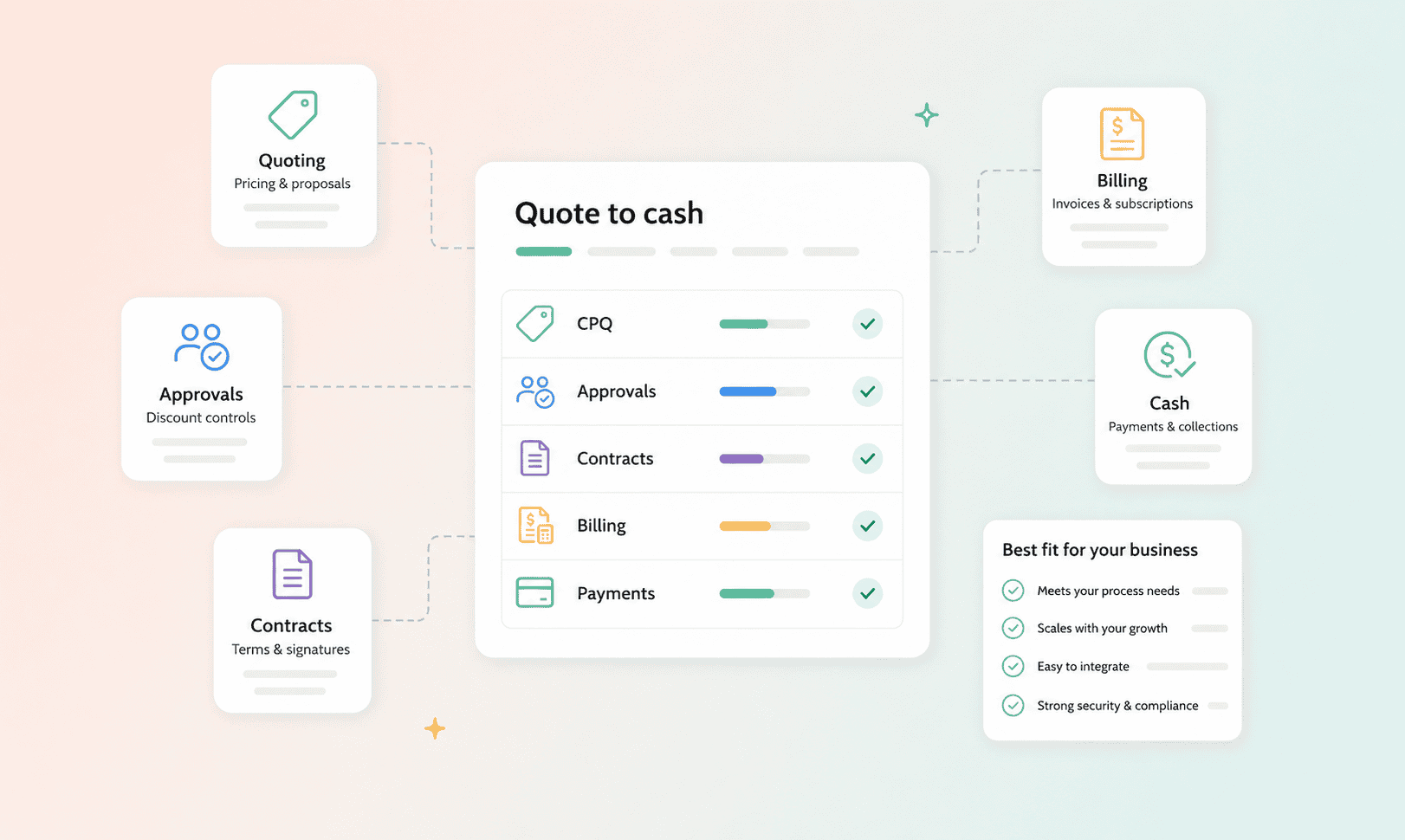
Quote-to-cash software manages the steps required to turn a sales quote into collected revenue, including pricing, approvals, contracts, billing, and payment.
But not every quote-to-cash tool covers that entire process. This guide breaks down the main types of software, when you need each one, and what to consider when comparing features, integrations, cost, and implementation.
Four kinds of software manage quote-to-cash: CPQ (configure, price, quote) tools for building and approving quotes, billing platforms for subscriptions and invoicing, contract lifecycle management (CLM) tools for agreements, and unified platforms such as Salesbricks that run quoting, signing, billing, and payment in one system. Which one you need depends on where your process breaks. If the problem sits inside one stage, such as getting complicated deals approved and quoted correctly or invoicing usage and renewals, a CPQ or billing tool built for that stage can fix it. If the errors come from the handoff between quoting and billing, a unified platform like Salesbricks removes that handoff instead of adding another tool to manage.
That distinction matters because "quote-to-cash software" covers products built from very different starting points.
Salesbricks, one system for SaaS quoting and billing, was built quoting-first, with billing tied to the quote, and brings CPQ, e-signature, billing, and payment into the same workflow instead of passing the deal between tools.
Your CRM and your accounting or ERP system sit on either side of these tools: the CRM holds the opportunity before anything is quoted, and the accounting system records the revenue once cash is collected.
Billing platforms have added quoting capabilities, while CPQ and document platforms increasingly extend into contracts and payments. So don't choose based on the category name alone. Look at the order of operations.
If a product was built around quoting, ask what happens after the customer signs. If it was built around billing, ask how the sales team gets from an opportunity to an approved, signed deal in the first place. If it's primarily a contract platform, ask where pricing and billing data live.
A unified platform takes a different approach: the quote becomes the transaction that drives what happens downstream. The best fit depends less on which product has the longest feature list and more on which handoff you're trying to eliminate.
You need quote-to-cash software when pricing, renewals, or entitlements get too complex to track by hand. The trigger is deal complexity, not deal volume.
Maybe one customer has ramped pricing, another pays by ACH, a third negotiated different renewal terms, and someone has to remember which features each customer bought. The spreadsheet-and-Stripe setup that worked for straightforward deals starts creating work between the systems.
That's usually what "outgrowing Stripe" means. Stripe is still perfectly good at processing payments, and Stripe Billing can run subscriptions, simple quotes, and invoices. What it isn't built around is the sales-led deal: negotiated terms, approvals, the signed contract, and keeping all of that matched to what gets billed, provisioned, and renewed.
Salesbricks treats Stripe as the card reader and itself as the point of sale: Stripe still moves the money, while Salesbricks runs the quote, contract, and billing around it. The goal isn't to replace Stripe; it's to stop manually carrying deal information from the quote into billing and then trying to reconstruct it later.
Quote-to-cash automation carries the same deal data from the approved quote through signature, billing, payment, and renewal, so nobody has to re-enter terms between systems. That matters because the expensive part of a manual process isn't usually creating the quote or sending the invoice, but the handoff between them.
Without automation, a customer signs a $60,000 contract with a first-year discount and quarterly billing. Someone then reads the signed agreement and manually recreates those terms in the billing system. Six months later, the customer adds seats. At renewal, someone has to work out which version of the deal is current.
With quote-to-cash automation, the approved quote becomes the agreement the customer signs. Those terms determine the subscription, invoice schedule, payment terms, and entitlements. Changes to the deal update the same underlying record rather than creating another document to reconcile later.
Stage by stage, automation replaces the manual step:
Revenue leakage often starts with something mundane: a discount entered incorrectly, an invoice that never gets created, or an upgrade that makes it into the CRM but not the billing system.
The features that matter most in quote-to-cash software are pricing and billing flexibility, handling of mid-term changes, CPQ controls, entitlements, and revenue visibility from one set of transaction data. Don't evaluate quote-to-cash software against the cleanest deal you sell. Test it against the awkward ones.
Can it handle a three-year contract with ramped pricing? A platform fee plus usage? Professional services on the same deal? An upgrade halfway through the term? These are the situations that expose whether the system supports your pricing model or just handles standard subscriptions.
What to check for each:
Here's a useful test: take three of your messiest real deals and try to model their entire lifecycle. A polished demo of the standard case tells you very little.
Yes. Most quote-to-cash software is designed to connect with your CRM, payment processor, and accounting or ERP system. But seeing an integration logo on a vendor's website doesn't tell you much about how useful that connection will be.
The better question is what data moves between the systems, and in which direction.
If a rep changes the customer, product, or deal terms in the CRM, does that flow into the quote automatically? When the deal closes, does the CRM get the final contract value and status back? And once billing starts, can sales or CS see what the customer actually bought without asking finance?
Those details matter because a weak integration can leave you with the same manual handoffs you were trying to remove.
Salesbricks connects with Salesforce, HubSpot, and Attio, alongside Stripe, QuickBooks, Xero, Slack, and Okta, with ERP integration available on the Enterprise plan.
When evaluating any quote-to-cash platform, map the data that needs to move across your existing stack. "Integrates with Salesforce" is much less useful than knowing exactly what happens when a quote changes, a contract is signed, or a subscription is amended.
Quote-to-cash software doesn't have a standard pricing model. Depending on the product, you may pay by user, transaction or billing volume, feature tier, or a negotiated contract. Published entry plans for SaaS-focused quote-to-cash and billing tools start at roughly $500 to $600 a month, while enterprise suites are usually custom-priced annual contracts.
That makes the headline subscription price only part of the comparison.
Before buying, look at what you'll also need to implement and maintain the system. Does it require consultants to configure? Are important integrations included? Will your team need to build custom workflows between quoting and billing? What happens to the price as transaction volume grows or you need more complex deal structures?
Salesbricks uses tiered pricing: its Startup plan starts at $500 per month and Growth at $1,500 per month, both billed annually, while Enterprise is custom-priced. The tiers differ on transaction volume, reporting, support, and integrations.
For more complex quote-to-cash systems, implementation, integration, administration, and migration can become meaningful parts of the total cost. A cheaper license isn't necessarily cheaper if Ops spends every month reconciling the gaps between systems.
Compare the cost of the software against the cost of the workflow it replaces, not just another vendor's monthly fee.
Most quote-to-cash implementations go wrong at data migration, not setup: moving customers who already have contracts, invoices, credits, payment terms, and renewal dates is the hard part.
The first mistake is treating setup and migration as the same project. You may be able to configure products, pricing, and quoting quickly while still having months or years of live customer data to clean up and move. As a rough guide, quoting setup on a lighter platform can take days, while migrating complex live billing data can take weeks.
A few things are worth sorting out before migration starts:
The implementation is a good opportunity to simplify the quote-to-cash process, not just relocate it. That's also where a unified platform like Salesbricks can help: instead of rebuilding the handoffs between separate quoting, contracting, and billing tools, you can bring those steps into one system.
If your biggest quote-to-cash problem is the handoff between quoting, contracts, payments, and billing, adding another point solution won't necessarily fix it.
Salesbricks is one system for SaaS quoting and billing. Sellers send buyers a dynamic checkout where they can review the deal, request changes, sign, and pay. Once the deal closes, the same structured transaction data carries into billing, subscriptions, entitlements, renewals, and revenue reporting.
Book a demo to see a deal go from quote to collected cash in Salesbricks.