30% of your revenue happens while you sleep
Founders don’t buy software during business hours, they buy software when it’s most convenient for them. That often happens after hours at 9 pm, 12 am, or even
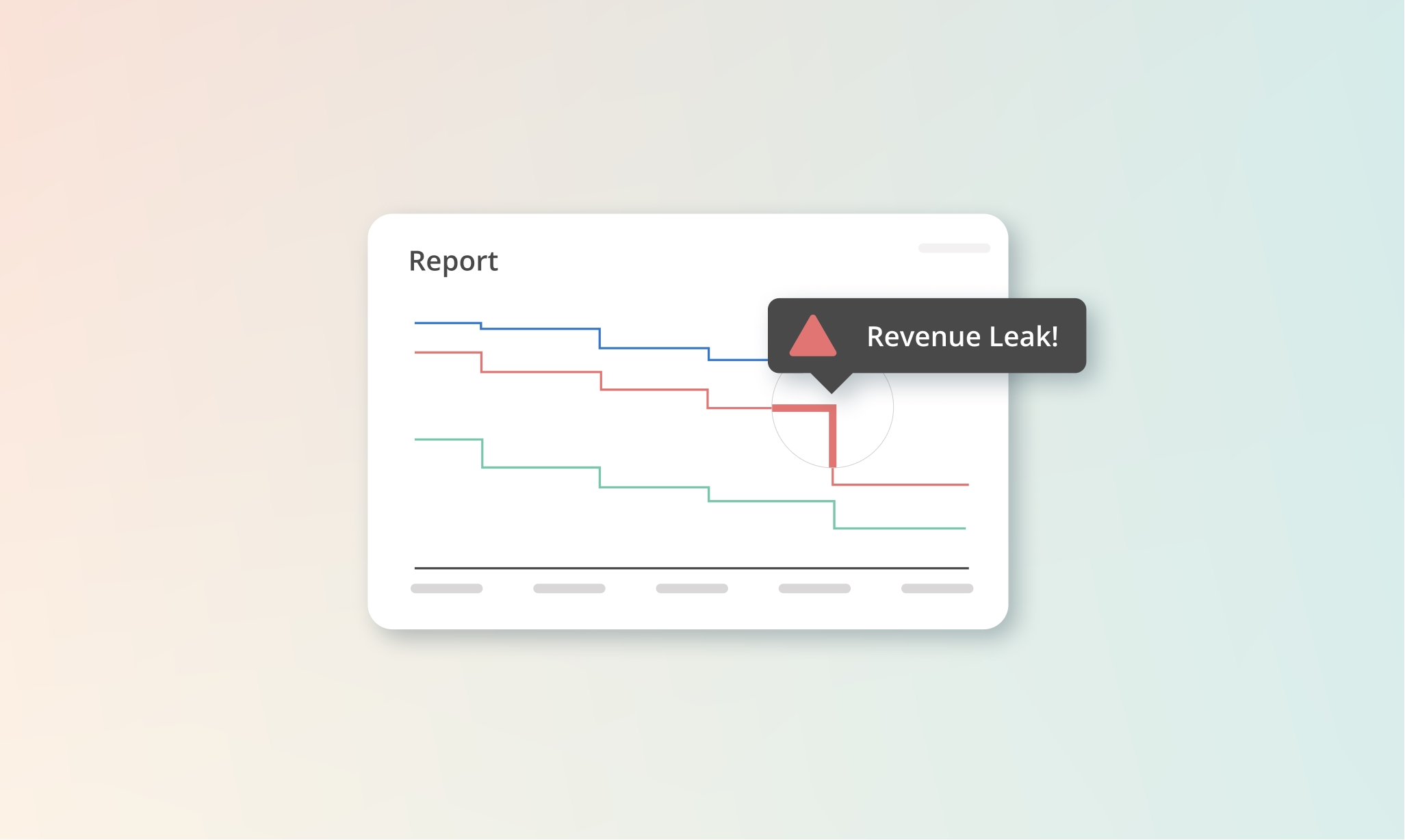
Revenue leakage is money you already earned but never billed or collected. A customer signed the contract, used the product, and owes you the cash. Somewhere between the signature and the invoice, that amount slipped through the process. That's different from churn, where a customer leaves, and different from bad debt, where an invoice went out and simply never got paid.
Most leakage doesn't start with bad intent. It starts with a sales rep closing a custom deal in a hurry, and a billing system that never gets word of the new terms. Growing companies often run quote-to-cash across Google Sheets, email threads, and a handful of disconnected tools. Manual handoffs hold up fine at a small scale, but they break as deal volume climbs, and the gaps between each handoff are where revenue quietly disappears.
According to BCG's research, 45% of business leaders call revenue leakage a systemic problem, and 59% of companies have no one dedicated to catching it. Closing that gap isn't abstract, either: BCG has found that companies that invest in fixing it typically recover 3% to 5% of revenue that was already theirs.
This article covers what revenue leakage means for a growing SaaS business, the formula to size your own gap, the four places it usually starts, why it costs more than the number suggests, and how to close it.
Revenue leakage is the gap between the revenue a company should receive under its contracts and the revenue it actually bills and collects.
For a SaaS business, this gap tends to show up in the space between five functions: pricing, quoting, billing, collections, and entitlements. A price gets agreed in one place, an invoice gets generated in another, and the two don't always match by the time cash lands in the bank.
In growing SaaS companies, this gap is almost always operational rather than intentional. Sales agrees to custom terms to close a deal. Finance bills a standard template that was never updated. Nobody owns the handoff between the two, so the difference between what was promised and what gets charged just sits there, unnoticed, month after month.
Four patterns account for most of what companies lose:
You may also see this problem described as top-line leakage, revenue leaks, unrealized revenue, contract leakage, or revenue assurance, depending on who in the company is raising it.
Leakage, churn, and bad debt get lumped together often, but each one starts in a different part of the business and gets fixed by a different team.
Churn happens when a customer leaves. The contract ends, the revenue ends with it, and everyone knows the moment it happened. Leakage is quieter. The customer stays, keeps using the product, and has no idea that what they're being charged doesn't match what they agreed to. The company simply fails to charge correctly or collect the full amount the contract allows.
Bad debt looks similar to leakage on the surface, but it starts at a different point. Bad debt means the invoice went out correctly, and the customer still didn't pay. Leakage usually starts earlier than that. The invoice may never have been sent at all, or it went out weeks late, or it went out with the wrong terms attached from the start.
Revenue loss is broader still. It covers revenue a company gives up on purpose, a customer who downgrades, a discount granted to win a renewal, or an add-on that gets canceled. The money was real, but the decision to let it go was deliberate, and that is what separates it from leakage. Leakage is revenue lost by accident; revenue loss is revenue lost by choice.
Here's how the four compare at the operating level.
Treating these four as one problem tends to send founders looking in the wrong direction. A retention play won't fix a billing error, and a stricter credit policy won't fix a discount that never made it into the invoicing system. Naming the problem correctly is what points you toward the actual fix.
Revenue Leakage = Expected Revenue − Collected Revenue
Leakage Rate (%) = (Expected Revenue − Collected Revenue) ÷ Expected Revenue × 100
Expected revenue comes from what your signed contracts and approved pricing terms say a customer owes. Collected revenue comes from cash that actually landed, verified through payment receipts. Everything sitting between those two numbers is leakage.
For example, for a SaaS company with $2M in expected annual subscription revenue and $1.85M actually collected, the gap is $150K, or 7.5% of expected revenue. That's a real number a founder can act on, not an abstract industry average.
To find where that gap is coming from, split the calculation into two stages instead of one:
Running the formula once a quarter is a useful check-in, but a few supporting metrics catch problems earlier:
Most companies don't catch this gap early because nobody is specifically watching for it; the contract-to-cash process runs without a single owner checking whether the numbers actually line up.
Most growth-stage SaaS companies don't have just a single leak. They usually have two or three running at the same time, each one small enough to miss on its own but large enough to add up by year-end.
The root cause is almost always the same across all four types: manual handoffs between systems that were never built to talk to each other. A deal gets negotiated in one tool, priced in another, billed in a third, and collected in a fourth. Every handoff between those tools is a place where a number can quietly change or disappear.
This rarely starts with a rogue sales rep trying to cut corners. It starts with a missing system. A deal closes over email, a discount gets approved on a quick call, and the billing tool never sees the final number that was actually agreed to.
From there, the same patterns repeat across different deals:
A CPQ system closes this gap by giving pricing and discounting a single source of truth that both sales and billing can see.
In startups without a dedicated billing ops function, invoicing tends to fall to whoever has time that week. That's a reasonable stopgap early on, but it's also where a surprising amount of revenue quietly slips away.
Common patterns include:
The solution here is to use a subscription management platform that keeps usage, upgrades, and billing terms in one place, so an upgrade updates the invoice automatically instead of depending on someone remembering to make the change.
Growing companies rarely have a formal collections process. What they have is a founder chasing overdue invoices between product meetings, hoping someone gets back to them.
The gaps usually show up as:
This part of revenue leakage is about cash conversion, not the general accounts receivable process. The invoice was correct. The money just hasn't landed yet, and nobody is actively working to close that gap.
Customer success teams at growing companies often grant extra access informally, just to keep a customer happy in the moment. Nobody logs it. Nobody bills for it. And it rarely gets undone once the moment has passed.
This shows up as:
This category is the hardest to catch because the customer is happy and nobody is complaining. The product is working exactly as expected. The company is simply giving away more than it's charging for, one small exception at a time.
Consider a typical case: a 3% leakage rate on $2M in annual revenue works out to $60K that was never billed or collected. That's not a rounding error on a spreadsheet. It's money the company already won, then lost through its own process.
It also shows up at a bad time: during due diligence. Investors look closely at how ARR converts into actual cash in the bank, and a persistent gap between the two raises questions about billing controls and operational maturity, even when the underlying business is healthy. A founder explaining away a leakage gap in a data room is a weaker position than a founder who never had the gap to explain.
Leaked revenue also hits EBITDA harder than the raw number suggests. The company already spent money to win that customer and already paid to serve them. Once the cost side is locked in, every dollar that never gets collected comes straight out of profit rather than blending into top-line noise. A leakage problem quietly becomes a margin problem.
There's a trust cost, too, one that's easy to miss. Recurring billing errors create real friction even with customers who have no intention of leaving. A wrong invoice, a discount that vanished without explanation, or a renewal at an unexpected price all chip away at confidence in the relationship. Some of what eventually gets logged as churn started months earlier as a billing mistake nobody fixed.
Every dollar should trace cleanly from contract clause to invoice to cash.
A better dunning sequence helps. A stricter discount approval policy helps too. But spot fixes like these still leave the underlying system fragmented, because they patch one point in the process while the rest keeps running on the same disconnected tools.
For most growing companies, the real issue is that commercial terms live in too many places at once. A signed PDF sits in one folder. A CRM note captures part of the story. A Slack message holds the rest. The billing system is always working from a partial picture, and that partial picture is exactly where revenue leaks.
Salesbricks connects quoting, contracts, billing, and entitlements into a single system, so there's no manual rekeying, no handoff errors, and no version drift between what was agreed and what gets charged.
Instead of routing non-standard terms through an ad-hoc chain of calls and approvals, Salesbricks uses structured workflows that capture the decision the moment it's made. Every charge ties back to a specific contract clause, so billing is traceable rather than assumed.
Renewals work the same way. Rather than carrying an old discount forward by default, renewal motions in Salesbricks give teams the chance to re-price intentionally, based on the terms that actually apply today.
None of this claims to eliminate leakage completely. What it does is close the specific gaps that come from undocumented decisions and default renewals, which is where a meaningful share of leakage tends to start.
The goal is one source of truth for commercial terms across CRM, billing, and entitlements, with no manual rekeying between systems.
In practice, the flow works like this: when a deal closes in Salesbricks, the billing terms, seat count, pricing tier, and renewal conditions all flow through automatically. No spreadsheet update. No copy-paste. No upgrade that quietly never makes it to the next invoice.
This is the same idea behind quote-to-cash as a discipline: treating the entire path from signed deal to collected cash as one connected process instead of a series of separate steps owned by separate teams.
Salesbricks is built for the exact point where manual processes start breaking under their own weight, giving growing companies the same kind of billing infrastructure larger companies rely on, without the months of setup that usually come with it.
Fixing revenue leakage starts with the formula, not a full rebuild of your systems. Run expected revenue against collected revenue for last quarter, see which category accounts for most of the gap, and fix the handoffs feeding that specific leak.
Leakage rarely comes from one bad decision. It comes from ordinary growth outpacing the manual processes a company started with, until pricing, billing, and collections stop talking to each other cleanly.
Run the formula against last quarter's numbers and see what it turns up. Then book a demo with Salesbricks to see how a contract-first system closes the handoff gaps before they turn into a permanent leak.