What Quote to Cash Software Do You Need
CPQ, CRM, billing, ERP, and unified platforms all claim to solve quote to cash. Here's what each category covers and how to choose.
For a usage-based SaaS company, a lot of next year's revenue is already in place. Some of it sits in signed commitments that will come up for renewal. The rest comes from pay-as-you-go customers who will keep consuming, or won't. Either way, the question is the same: how much of it will you keep?
Usage-based renewals rarely fail loudly. A customer doesn't usually cancel. They consume less, renew at a smaller commitment, or let their usage slowly fade. By the time it shows up in revenue, the decision was made months earlier.
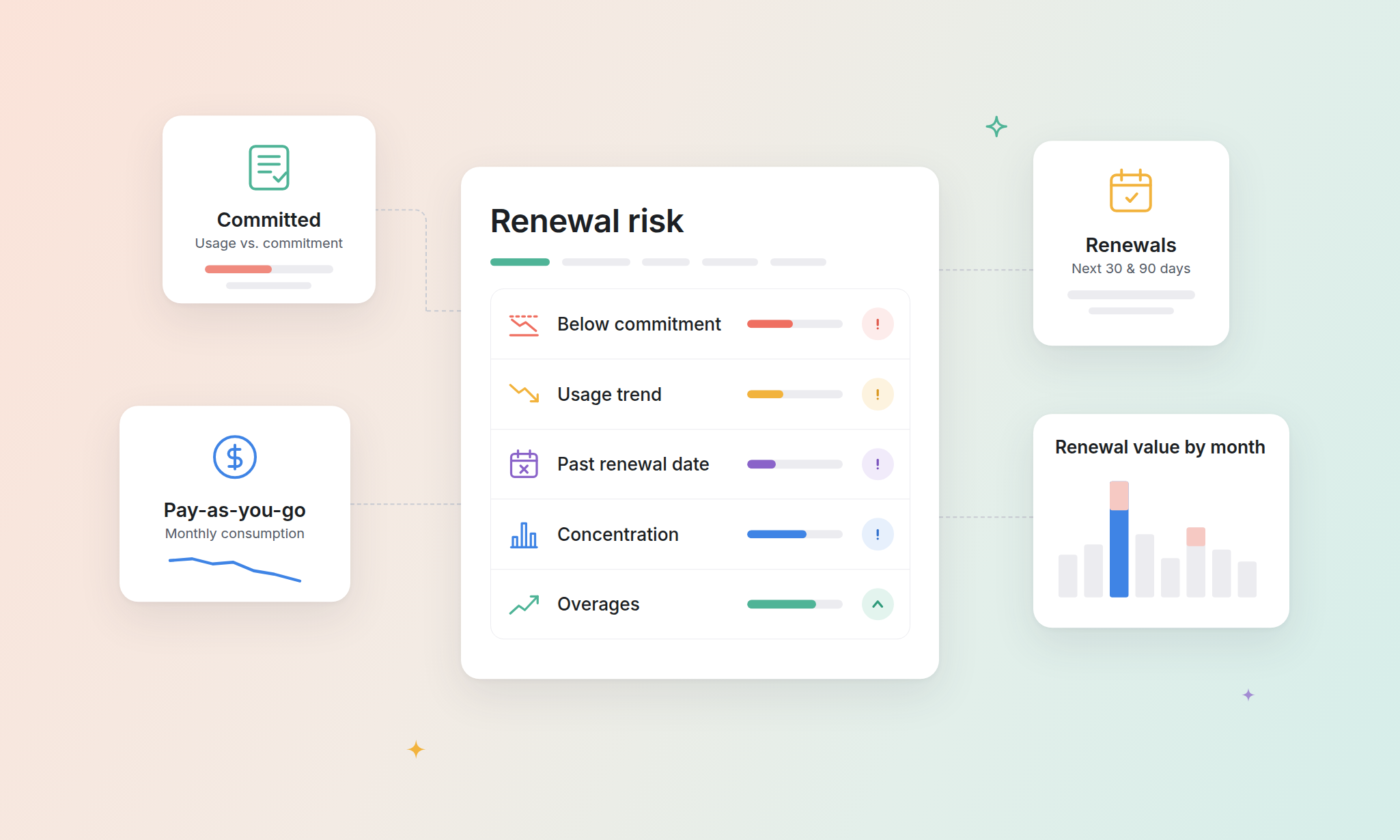
The good news is that usage-based pricing makes renewal risk easier to see than seat-based pricing does, as long as you're watching the right signals. This guide covers what renewal risk looks like for usage-based SaaS, the five early warning signs that matter most, and a simple rhythm a lean RevOps or finance team can use to act on them.
Renewal risk in usage-based SaaS is the chance that a customer will spend less with you in the future, whether by leaving, renewing at a smaller commitment, or steadily consuming less. Unlike seat-based SaaS, where a renewal is mostly a yes-or-no decision, usage-based renewals usually come down to how much.
That changes what you're watching for. In usage-based SaaS, the biggest risk is often not churn but downsell: a customer who stays but commits to less. Downsell is easy to miss because the customer is still active, still paying, and still technically renewing.
Most usage-based SaaS companies have a mix of two kinds of customers, and renewal risk looks different for each.
Committed customers agree to a minimum spend or volume over a contract term, often annual, with overages or a true-up if they go over. They have a renewal date, and at that date the commitment gets renegotiated. The risk is that the new commitment is smaller than the old one, or that the customer doesn't renew it at all.
Pay-as-you-go customers have no commitment and no renewal date. They pay for what they use, month by month. For them, "renewal" is continuous: every month, they decide again how much to use. The risk is a gradual decline in consumption that nobody notices until revenue is noticeably lower.
The two groups need slightly different attention, but they share one thing: consumption is the clearest signal of where each customer is heading.
For committed customers, the renewal date is a deadline, not an early warning. A customer who has been consuming well below their commitment for six months already knows they're over-committed. When the renewal conversation starts, they arrive ready to cut. If your team only finds out in that conversation, there's little room to change the outcome.
For pay-as-you-go customers, there's no date at all, which makes it even easier for a decline to go unnoticed.
The teams that hold on to the most revenue see these trends three to six months out. That's early enough to find out what changed, help the customer get more value, and shape the renewal before it becomes a negotiation. Doing that well is one of the biggest levers on net revenue retention.
Applies to: committed customers
A customer consistently using less than they committed to is the clearest early sign of a smaller renewal. They're paying for capacity they don't use, and they'll want to fix that at the next renewal.
Consider an example. A customer signed a $60,000 annual commitment for your API, with overages billed above that. Their renewal is 90 days away. Invoices are paid and there are no open support tickets. But their monthly usage has fallen from about 2 million calls to 700,000 over the past quarter, and they're on track to use only around half of what they committed to.
That customer is very unlikely to renew at $60,000. Seen 90 days out, there's still time to act. Find out whether a project paused, a workload moved elsewhere, or a rollout stalled. Help them get back on track, or right-size the commitment on your terms, before they arrive at the renewal asking for a cut.
Applies to: committed and pay-as-you-go customers
A steady decline in consumption is a warning sign even when a customer is still within their commitment, and for pay-as-you-go customers it's often the only one you'll get.
The key word is trend. Usage-based revenue is naturally noisy. Seasonality, one-off batch jobs, holidays, and ramp periods all cause swings from month to month. A single quiet month means little. Consumption falling consistently over 60 to 90 days, without an obvious reason, means something has changed for that customer.
For pay-as-you-go customers, this is the whole early-warning system. There's no renewal conversation where a decline gets raised, so it has to be spotted in the data and followed up proactively.
Applies to: committed customers
A commitment that reaches its end date without a renewal in place is at risk, even if the customer hasn't said anything. Sometimes it's just late paperwork. Sometimes nobody owned the renewal, and the customer quietly drops to pay-as-you-go or stops using the product.
At a growing company, lapsed renewals are usually a process problem: renewals tracked in a spreadsheet nobody reviews, or ownership split between an account executive, customer success, and finance with no one clearly responsible. A short weekly review of renewals past their date catches the ones that only need a signature and surfaces the ones that need a real conversation.
Applies to: committed and pay-as-you-go customers
Renewal concentration is when a large share of your revenue depends on a single month or a small number of customers. Both are common at growth-stage usage-based companies.
Concentration by month happens when a strong quarter of new deals becomes a heavy quarter of renewals twelve months later. Concentration by customer happens because usage-based revenue tends to follow your biggest customers' growth: a handful of large accounts can make up a significant share of total consumption.
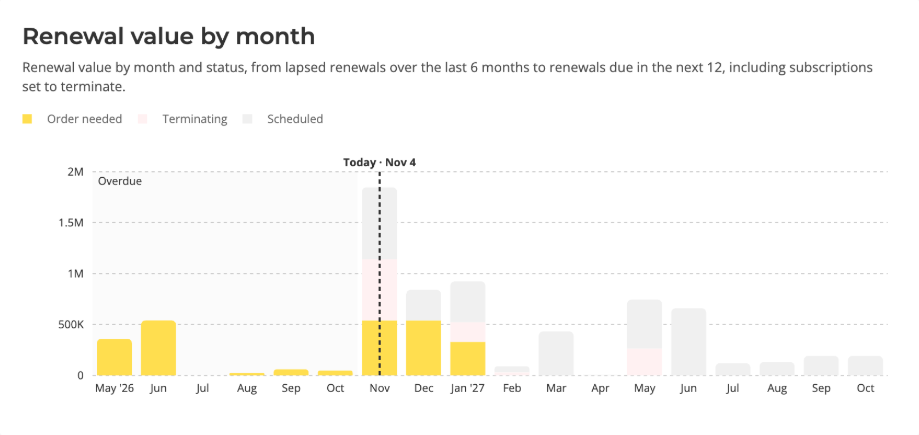
Neither is a problem on its own, but both raise the stakes. A downsell from one large customer in a heavy renewal month can move your whole quarter. Looking at renewal value month by month, at least twelve months ahead, and knowing which customers drive the most consumption, shows you where to start renewals earlier and pay closest attention.
Applies to: committed and pay-as-you-go customers
Not every signal is a warning: customers consuming more than expected are your best expansion opportunities.
A committed customer who regularly exceeds their commitment and pays overages is a natural candidate for a larger commitment, often at a better rate for them and more predictable revenue for you. A pay-as-you-go customer whose usage keeps climbing is a candidate to move onto a committed contract, which turns variable revenue into contracted revenue.
The mistake is treating these customers as fine and leaving them alone. Flagging them ahead of time means the next conversation is about growth, not just retention.
Most growth-stage teams aren't ignoring renewal risk. They just can't see it in one place. The data behind these signals usually lives in different systems:
Each system shows part of the picture. The billing tool can tell you a customer is under-consuming, but acting on it means changing the commitment at renewal, and that happens in quoting. When billing and quoting live in separate systems, the signal and the action are disconnected. Someone has to notice the trend in one place, remember it, and carry it into another.
Spreadsheets fill the gap for a while. But as customer count and pricing complexity grow, with ramps, true-ups, overages, and mid-term changes, keeping them accurate by hand stops being realistic.
Forecasting renewal revenue for usage-based SaaS means forecasting both whether customers renew and how much they'll consume. A practical approach for a lean team:
Reviewing this monthly, from one consistent view, keeps the forecast close to what will actually happen.
You don't need a large customer success team to manage renewal risk. You need a consistent rhythm and one place to look.
| When | What to do |
|---|---|
| Weekly | Review renewals past their date and any terminating subscriptions. Make sure each upcoming renewal has an owner. |
| Monthly | Check consumption against commitment for every committed customer, and usage trends for your largest pay-as-you-go customers. Flag anyone falling behind or growing fast. |
| 90 days before renewal | Review the customer's consumption over the term. Decide whether the conversation is about recovery, right-sizing, or expansion. |
| 60 days before renewal | Start the commercial conversation, with a proposed commitment based on actual usage. |
| 30 days before renewal | Put the renewal order in front of the customer, so signing is the only step left. |
Larger customers, or those with procurement processes, may need you to start earlier. The point is to decide the rhythm once and apply it to every customer, not just whichever renewal happens to be closest.
Salesbricks is a quote-to-cash platform for B2B SaaS companies, including those with usage-based pricing. Quoting, contracts, subscriptions, and usage-based billing all run in one system. So a customer's consumption, their commitment, and their renewal sit together, and the renewal quote is built in the same place.
The Salesbricks Renewals dashboard gives revenue teams one view of what's coming due and what's at risk:
Because usage billing runs in Salesbricks, consumption for each customer is available alongside their contract, so under-consumption and overages are visible before the renewal, not after. When it's time to renew, the new commitment is quoted in the same system that tracked the usage behind it.
Start with the committed revenue renewing in the period, remove subscriptions already set to terminate, and adjust each committed customer toward their actual consumption rather than their current commitment. Then add expected expansion from customers paying overages, and forecast pay-as-you-go revenue from 60 to 90 day usage trends.
They usually ask to renew at a smaller commitment, which is a downsell. The best way to handle it is to spot the under-consumption months before renewal, understand why it's happening, and either help the customer get back on track or propose a right-sized commitment yourself.
Pay-as-you-go customers don't have a renewal date, but they effectively decide whether to keep using your product every month. Watching their consumption trends is the only way to spot risk early. Fast-growing pay-as-you-go customers are also strong candidates to move onto a committed contract.
The main signs are consumption running below a customer's commitment, a steady decline in usage over 60 to 90 days, and renewals passing their date without action. A falling trend matters more than a single quiet month, since usage-based revenue naturally varies.
Renewal concentration is when a large share of your recurring revenue depends on a single month or a small number of customers. It increases risk because a downsell or loss in that month, or from one large customer, has an outsized effect on revenue.
It varies: often an account executive, customer success, or a founder for the largest accounts, with finance involved in forecasting. What matters most is that every renewal has one clear owner. The biggest risk isn't the wrong owner, it's having none.
In usage-based SaaS, the revenue you keep depends on more than whether customers renew. It depends on how much they commit to and keep consuming. Watching consumption against commitment, usage trends, slipping renewals, concentration, and expansion signals, well ahead of any renewal date, turns renewals from a negotiation you react to into one you shape.
Want to see renewals and usage in one place? Book a Salesbricks demo.